 EN
 ES
 FR
 FA
 JA
 DE

In low-voltage automotive signal transmission systems, terminal back-out represents a hidden electrical failure with high warranty and recall costs. According to automotive wiring harness quality data, terminal displacement caused by incomplete insertion or high-vibration operating conditions serves as the primary driver of fretting corrosion, intermittent circuit disconnections, and signal loss.
For global sourcing professionals and wiring harness engineers, evaluating whether an automotive connector incorporates a robust secondary locking structure—such as Terminal Position Assurance (TPA) and Connector Position Assurance (CPA)—and understanding its mechanical retention limits under USCAR-2 specifications is critical to establishing a resilient supply chain.
1. Primary Locking Mechanisms: Load Limits and Failure Modes
The crimped terminal is inserted into the cavity of the plastic housing, achieving initial retention via plastic lances molded inside the cavity or metal lances stamped onto the terminal itself.
Mechanical Assembly Flow:
Terminal Insertion -> Deflects Housing/Terminal Lance -> Clears Retention Ledge -> Lance Rebounds to Engage
In real-world applications, relying solely on primary locking fails to meet the full-lifecycle vibration requirements of automotive vehicles due to three physical limitations:
- Restricted Retention Force: For micro-signal terminals (such as 0.64 mm system size), the retention force of a single primary plastic lance typically ranges between 30 N and 40 N. This easily exceeds its load limit under axial pulling forces or severe wire harness bending.
- Thermal Creep of Plastics: Automotive environments experience severe thermal cycles ranging from -40°C to +125°C. Under sustained high-temperature stress, engineering plastics like PBT undergo plastic deformation, causing initial retention force to decay over time.
- Incomplete Insertion Risk: If a terminal is not fully seated to the bottom during harness assembly, the primary lance fails to snap over the retention ledge. While the connector may pass continuity testing on the factory floor, the terminal will physically back out when exposed to operational vehicle vibration.
2. TPA Mechanism: Physical Anti-Backout and Foolproof Assembly
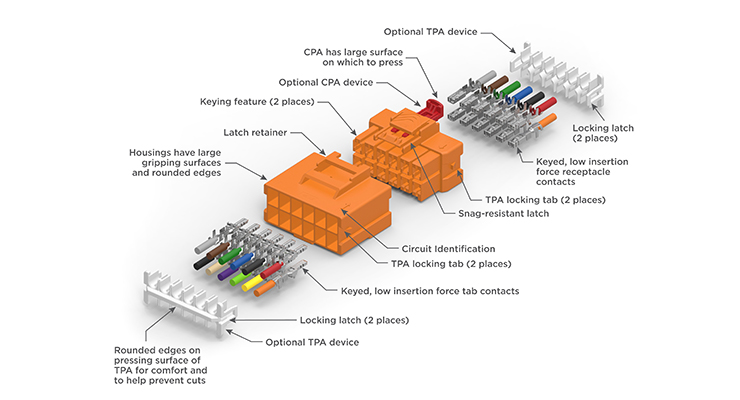
To overcome the inherent limits of primary locking, automotive connectors incorporate Terminal Position Assurance (TPA) components. A TPA does not replace primary locking; instead, it functions as a secondary physical locking mechanism that works in tandem with the primary lance.
TPA Foolproof Assembly Logic:
- Incomplete Insertion Scenario: Terminal Unseated -> Primary Lance Elevated -> Blocks TPA Wedge Entry -> Assembly Fault Triggered (Poka-Yoke Warning)
- Proper Insertion Scenario: Terminal Fully Seated -> Primary Lance Rebounds -> Clears Entry Path -> TPA Wedge Locks Flush (Terminal Retention Force > 80 N)

Taking benchmark automotive low-voltage signal connectors—such as the TE Connectivity TH/.025 Series 1379658-1—as an example, the integrated TPA design delivers two major engineering benefits:
- Structural Redundancy and Force Amplification: Once fully engaged, the TPA wedge inserts directly into the void behind the terminal shoulder. When axial pulling force is applied to the wire, the strain shifts from the single plastic lance to the rigid TPA block, boosting terminal retention force to over 80 N and eliminating pull-out failures.
- Enforced Assembly Error-Proofing (Poka-Yoke): If any individual terminal is unseated, the un-rebounded primary lance directly obstructs the TPA wedge. Harness assembly operators can detect this immediately through tactile resistance or automated pneumatic testing, achieving 100% detection of improperly seated terminals.
3. System-Level Protection: Differentiating TPA and CPA
When evaluating interface reliability across wire-to-board connectors and wire-to-wire harnesses, procurement and engineering teams must distinguish between TPA and CPA (Connector Position Assurance) across their operational levels:

| Locking Mechanism | Operational Level | Physical Function | Primary Failure Prevention |
| TPA (Terminal Position Assurance) | Terminal-to-Housing | Prevents crimped terminals from backing out of the plastic cavity | Prevents open circuits and fretting corrosion caused by wire pulling |
| CPA (Connector Position Assurance) | Housing-to-Housing | Locks the main latch between mating male and female connector housings | Prevents full connector disengagement due to high vibration or accidental impact |
For high-vibration zones such as doors, instrument panels, and powertrain peripherals, specifying connector assemblies sourced through authorized distributors like Suzhou Suqin Connectors with triple protection—Primary Lance, TPA, and CPA—is recommended to ensure absolute position stability for both terminals and housings.
4. Global Sourcing Evaluation & USCAR-2 Qualification Standards
When qualifying new cross-reference alternatives from manufacturers like TE Connectivity or Yeonho, technical buyers should reference the following objective metrics:
- Terminal Retention Force Test: Conduct tensile testing per USCAR-2 standards under both primary-lock-only and TPA-engaged conditions. For 0.64 mm connector systems, the destructive terminal pull-out force with TPA engaged must consistently exceed 60 N to 80 N.
- Fretting Corrosion and Contact Resistance: During sinusoidal and random vibration testing combined with thermal cycling, contact displacement must remain within micro-meter scales. Post-test contact resistance delta must meet Delta R <= 10 mΩ.
- Harness Assembly SOP Execution: Ensure harness manufacturing lines strictly adhere to the “Push-Click-Pull” standard operating procedure: Push the terminal until seated, Click/Engage the TPA, and Pull gently on the wire to confirm locking integrity, supplemented by electrical test bench probe-depth verification.